
Technology Roadmap Gantt Chart Template
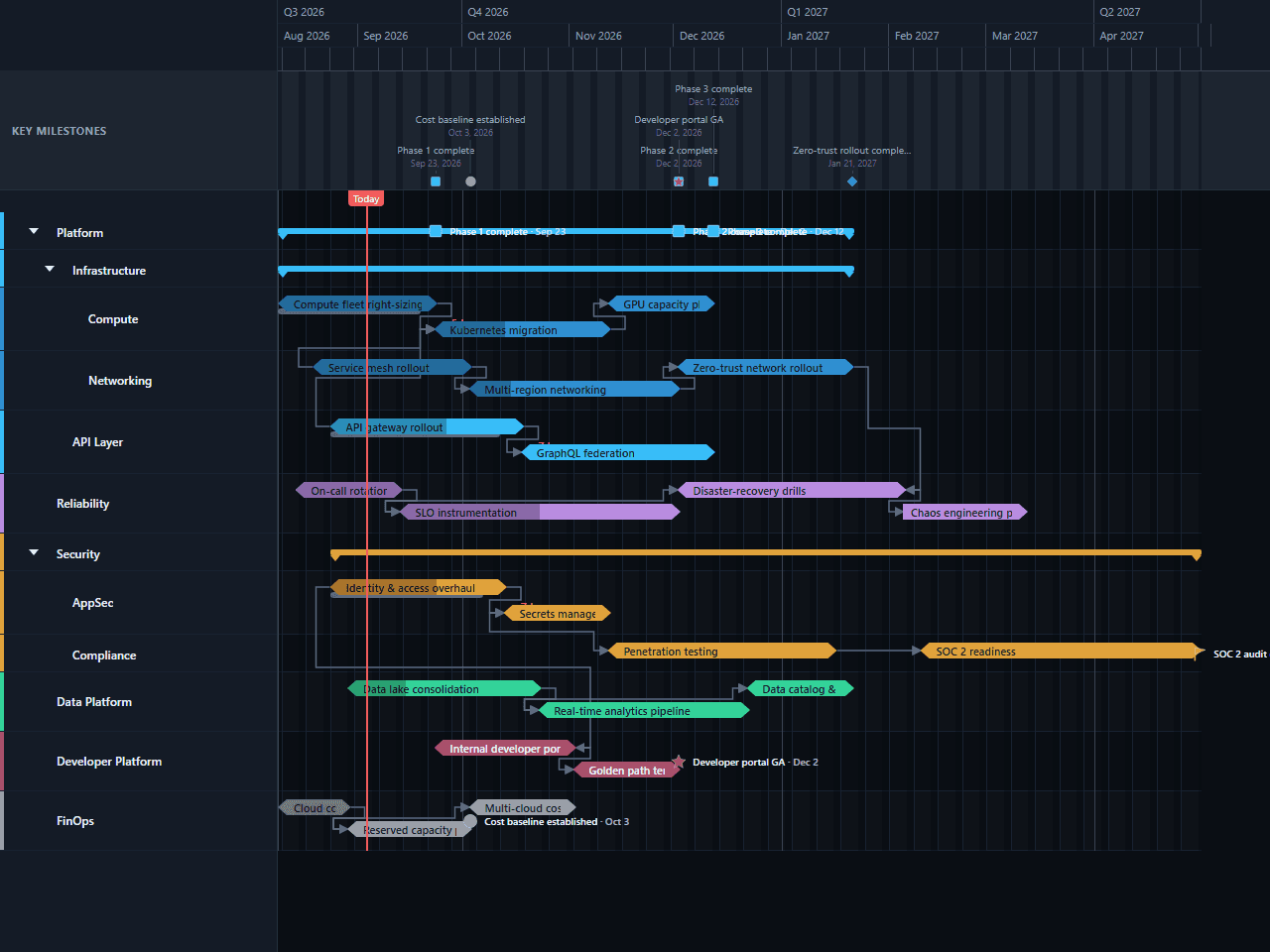
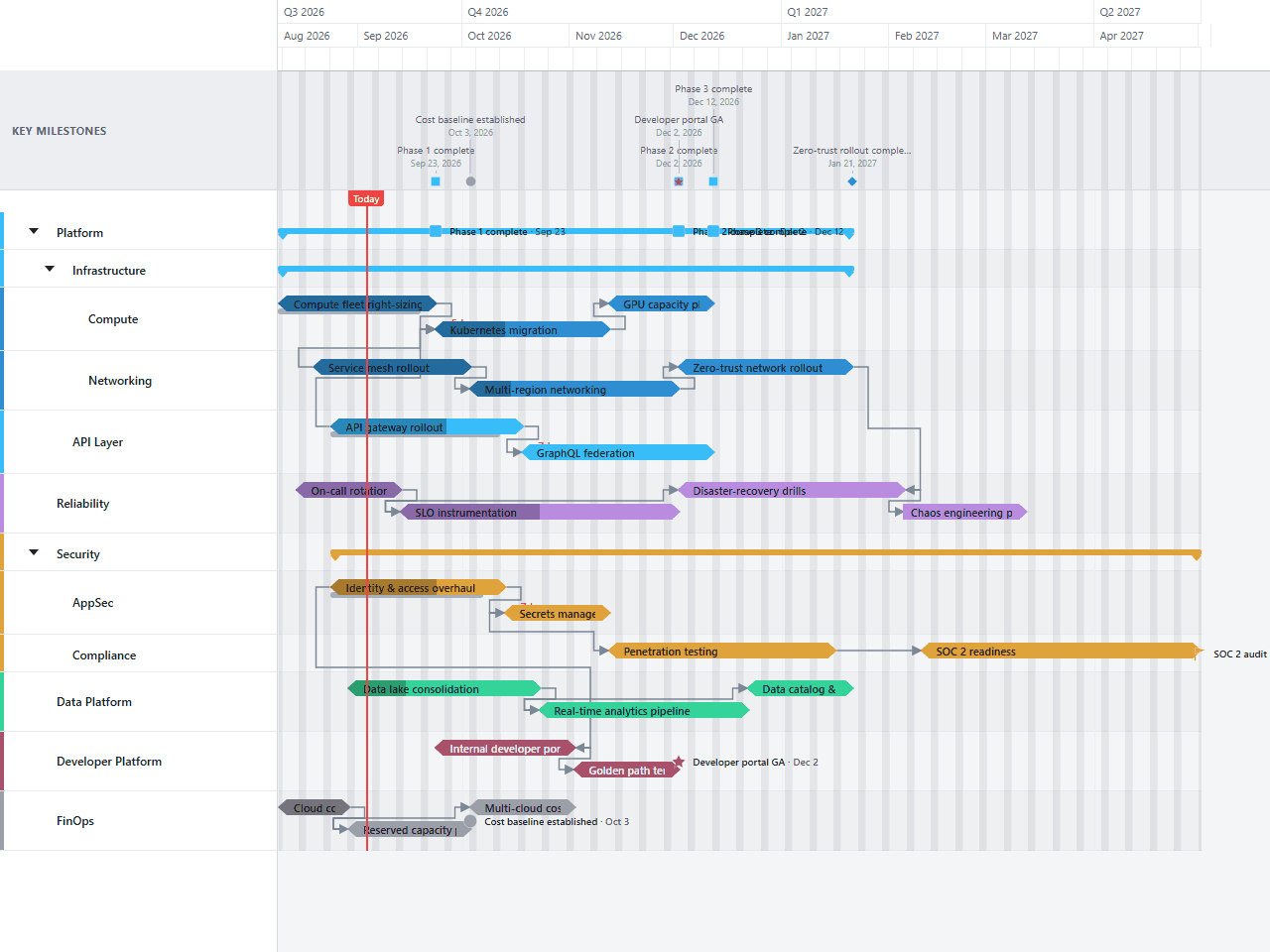
A technology roadmap running platform modernization — nested three deep into infrastructure, then compute and networking — alongside reliability, a security track split into application security and compliance, a data platform, an internal developer platform, and FinOps. A finish-to-finish link keeps a zero-trust network rollout aligned with disaster-recovery drills, and a start-to-finish link ties the developer portal’s completion to when the identity overhaul begins. A fit for an IT or platform team tracking several initiatives that share deadlines but not owners.
- Platform
- Reliability
- Security
- Data Platform
- Developer Platform
- FinOps
Download the plan free as a CSV: phases, tasks, dates, and dependencies, ready to open in Excel, Google Sheets, or Numbers. Open it in GanttFlow instead and it drops in as a fully editable, presentation-ready Gantt chart (Pro).
Infrastructure work has to be sold before it can be scheduled. Nobody outside engineering asks for compute right-sizing, and the work that prevents an outage is invisible in exactly the way that makes it hard to fund. This template is built to make that work legible: six workstreams, one of them nested three deep, three named milestones, and about six months of visible sequence.
Who this technology roadmap template is for
This is for a platform lead, head of infrastructure, or CTO at a company where engineering investment needs an argument. It assumes you run multiple concurrent tracks: the platform itself, the reliability practice around it, a security or compliance programme, data infrastructure, developer tooling, and cloud spend, with overlapping people and a shared budget.
The audience is generally a mix: an executive who needs to approve the spend, a peer engineering leader who needs to plan around it, and your own team who need to know what happens after the current thing.
What goes on a technology roadmap?
Six top-level lanes, one nested three deep.
Platform splits into Infrastructure (itself split into Compute (fleet right-sizing, then GPU capacity planning) and Networking (a service mesh rollout, then a zero-trust rollout)) and an API Layer (a gateway rollout).
Reliability runs an on-call rotation redesign, disaster-recovery drills, and a chaos engineering program in parallel rather than in sequence.
Security splits into AppSec (an identity and access overhaul) and Compliance (SOC 2 readiness), the longest single commitment on the chart.
Data Platform runs a data lake consolidation into a real-time analytics pipeline.
Developer Platform runs an internal developer portal into golden path templates.
FinOps runs cloud cost tagging into reserved capacity planning and a multi-cloud cost dashboard.
Three milestones mark real completions: the zero-trust rollout finishing, SOC 2 readiness being audit-complete, and the developer portal reaching general availability: one on Networking, one on Compliance, one on Developer Platform, deliberately spread across three different tracks rather than clustered on one.
How long does infrastructure work take?
The template spans about six months, and the bars are long by design: infrastructure work doesn't come in two-week pieces.
Platform, Reliability, Security, and Data Platform all run about sixteen weeks end to end, deliberately close together, since four tracks with genuinely different lengths would suggest one of them was under-planned. Developer Platform is the shortest at ten weeks, and FinOps runs about twelve.
The shape worth noticing is that SOC 2 readiness alone is an eleven-week bar sitting at the far end of Security. If your team is fixed-size, that's a resourcing problem the chart has just made visible, and it's much better discovered in planning than in month five.
How dependencies work on this roadmap
Five links, deliberately few. Three are finish-to-start, each within a single track: cloud cost tagging finishes before reserved capacity planning starts; the data lake consolidation finishes before the real-time analytics pipeline starts; and the internal developer portal has to exist before golden path templates can build on it.
One is start-to-start: reserved capacity planning is keyed to when the multi-cloud cost dashboard starts, not when it finishes: the dashboard begins as soon as capacity planning is underway rather than waiting for a signed-off number.
One is start-to-finish, and it's the one worth naming directly: the developer portal's completion is gated by when the identity and access overhaul starts, not by identity finishing. The portal needs a stable auth model to build against, not a fully closed-out security overhaul.
Reliability, Security, FinOps, and the rest are deliberately not linked to each other, because the real constraint between them is shared headcount rather than sequence. A Gantt chart models sequence well and resource contention badly: when several tracks all thicken in the same quarter, the chart is telling you something real about capacity even though no arrow connects them, and that's the conversation to have when presenting it.
What to change for your own roadmap
Rename the tracks to your actual functions
Platform, Reliability, Security, Data Platform, Developer Platform, and FinOps are six common ones, but if you run a mobile platform team, give it its own lane rather than folding it in.
Anchor any externally imposed dates first
SOC 2 readiness in this template stands in for any compliance deadline. If you have a real audit date, place that milestone first and build backwards: compliance dates don't move for your roadmap.
Check the back half against your headcount
Add up how many bars overlap in the final quarter. If the answer is more concurrent workstreams than you have teams, either stagger them now or be explicit about what will slip.
Add the milestones your organisation will actually ask about
Zero-trust complete, SOC 2 audit-complete, and developer portal GA are three real completions, not placeholders. Add more where a specific stakeholder needs a specific date to hold you to.
Zoom out to months
Six months at day resolution is unreadable. The month view is the one you'll present from.
Common mistakes on technology roadmaps
No milestones. Infrastructure work without checkpoints reads as an open-ended cost, and open-ended costs are the first thing cut.
Every track starting in January. Real infrastructure programmes have work already in flight. Bars that start before the chart's zero point are honest, not untidy.
Ignoring capacity. Six lanes on a chart don't mean six teams. If the same engineers appear in every lane, the chart is fiction.
Compliance work sized optimistically. SOC 2, ISO, and similar programmes almost always take longer than the engineering effort suggests, because most of the elapsed time is evidence collection and external scheduling.
Never showing it outside engineering. The whole point of drawing infrastructure work is that other people can see it. A roadmap that stays inside the platform team hasn't done its job.
Making the case with this chart
The audience for a technology roadmap is usually holding a budget. Export a PDF for the funding conversation and a PNG for the quarterly engineering update, and re-export as the bars move. Because nobody needs an account to open it, the chart travels, which is the entire mechanism by which invisible work becomes fundable work.
Questions about this template
- What is a technology roadmap?
- A timeline of infrastructure and engineering investment planned at the altitude of a programme rather than a project. This template covers about six months across six workstreams: Platform nested three deep into Infrastructure, then Compute and Networking, plus an API Layer, alongside Reliability, a two-part Security track, Data Platform, Developer Platform, and FinOps. It's the chart you use to justify work that has no customer-visible feature attached to it, which is most of what an infrastructure team does.
- How do I get funding approved for infrastructure work with no visible output?
- Show it as a sequence with named completions rather than as a continuous cost. This template's three milestones exist for exactly that: they turn six months of platform, compliance, and developer-tooling work into checkpoints a finance or executive audience can hold you to, which is far easier to approve than an open-ended reliability budget.
- Why does the developer portal depend on the identity overhaul starting, not finishing?
- Because the portal needs a stable auth model to build against, not a fully closed-out security overhaul. This template links the portal's *completion* to when identity work *starts*, a start-to-finish dependency, the one type most teams never reach for. A finish-to-start link would force the portal to wait for security to be entirely signed off, which is a stricter and slower constraint than the real one.
- How long should a technology roadmap look ahead?
- Three to four quarters, roughly what this template covers. Long enough to see a compliance cycle like SOC 2 readiness through, short enough that the later bars are still meaningful. Infrastructure roadmaps that look two years out are budget documents, not plans.
- Why don't Reliability, Security, and FinOps depend on each other?
- Because in this template they genuinely don't: each runs its own internal sequence. The real contention between them is people, not sequence, and a Gantt chart shows that better through parallel lanes than through arrows. If your security work is actually blocked on a platform delivery, add that link explicitly.