
Program Roadmap Gantt Chart Template
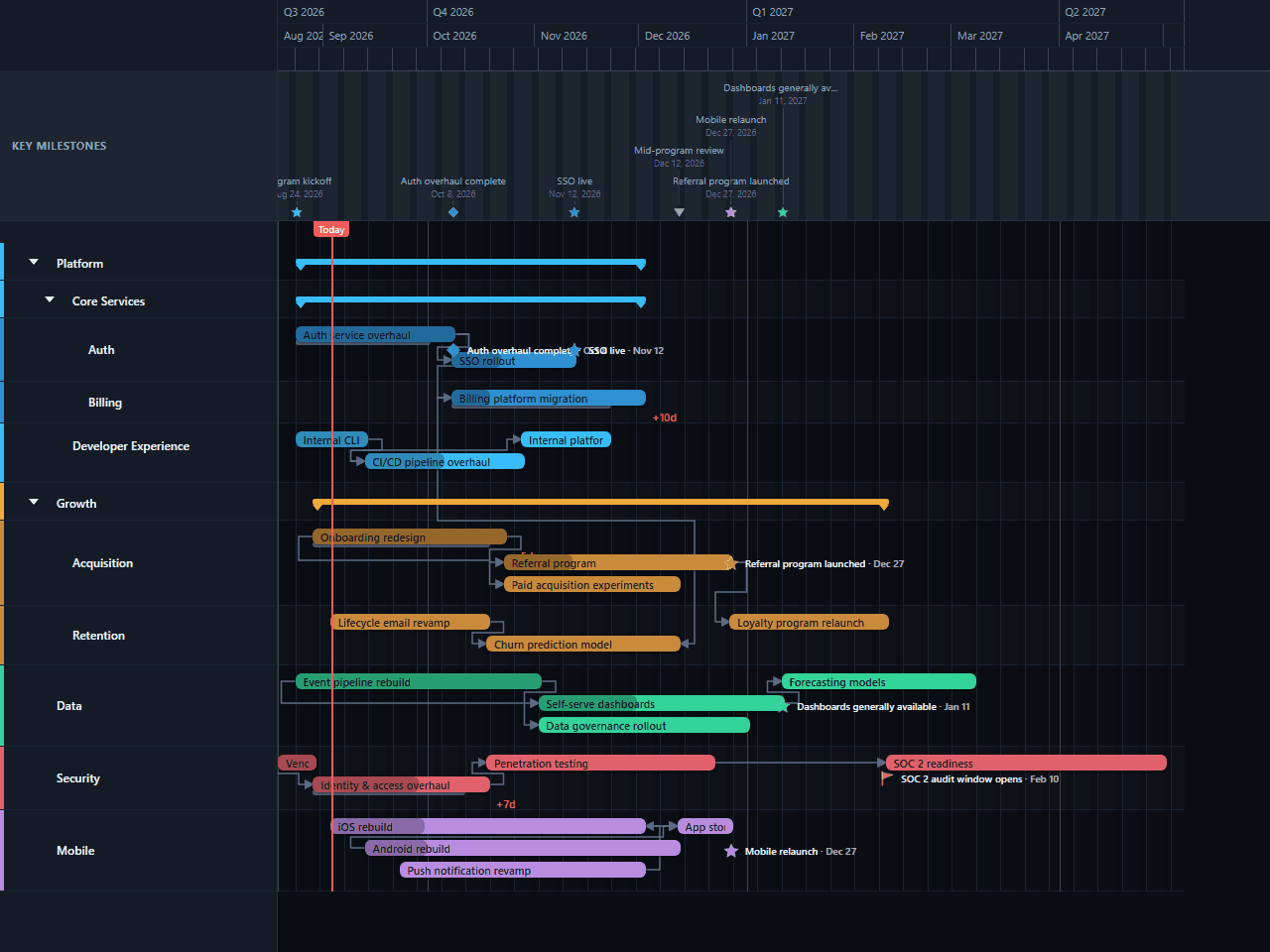
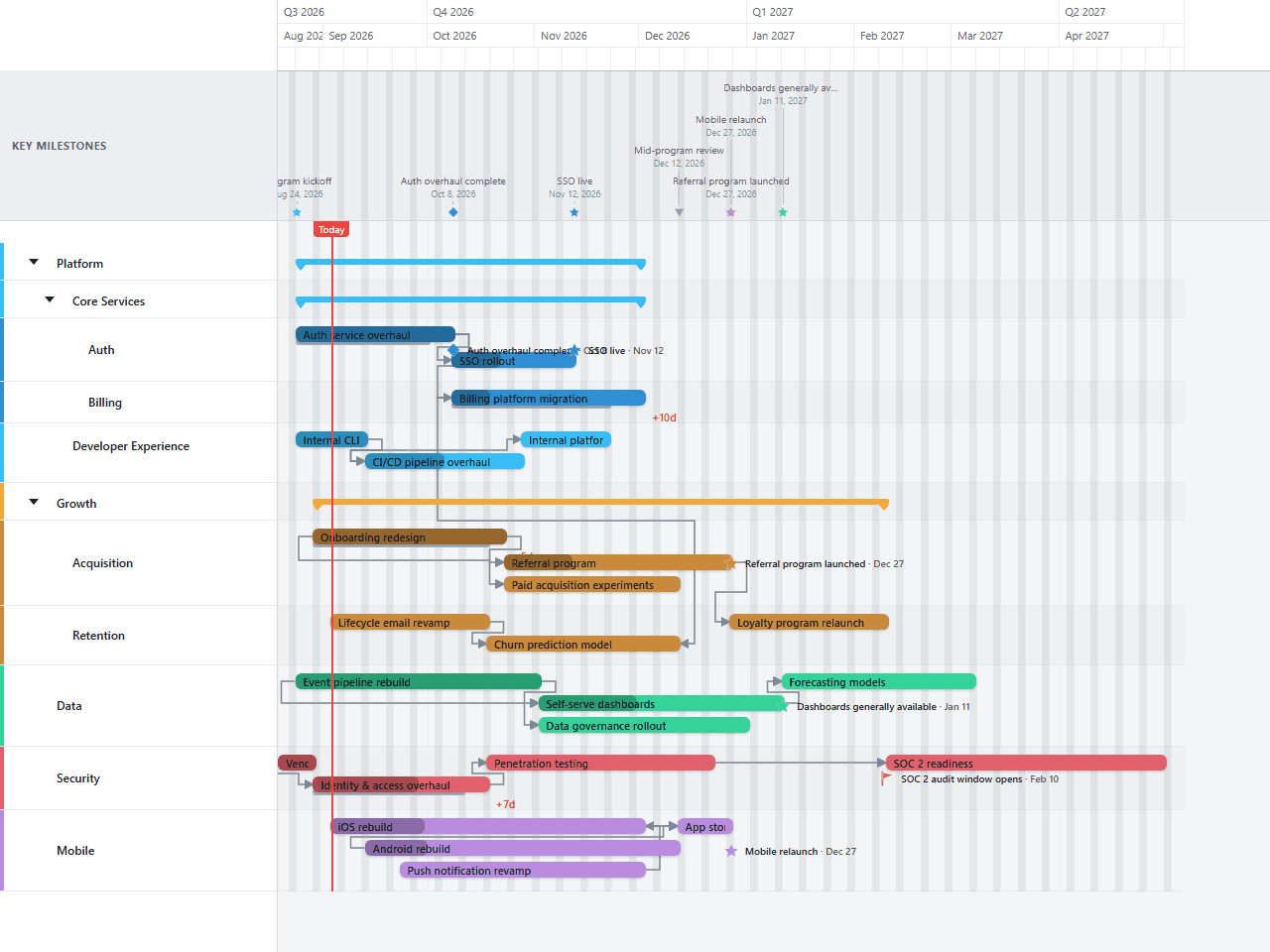
A cross-team program roadmap tracking Platform — nested three deep into Core Services, then Auth and Billing — alongside Growth, Data, Security, and Mobile, all on one shared timeline. Star milestones mark releases across every team, most of them ribbon-first so a scanning executive gets the headline dates without opening the grid, and a start-to-finish link keeps a data workstream honest against a billing migration it depends on but doesn’t control. Built for a program manager coordinating several teams toward common dates none of them fully owns.
- Platform
- Growth
- Data
- Security
- Mobile
Download the plan free as a CSV: phases, tasks, dates, and dependencies, ready to open in Excel, Google Sheets, or Numbers. Open it in GanttFlow instead and it drops in as a fully editable, presentation-ready Gantt chart (Pro).
The hardest thing about a program roadmap isn't building it. It's keeping it at the right altitude: detailed enough to say something, coarse enough that five teams can each see themselves in it without it becoming a merged backlog. This template is calibrated for that: five teams, one of them nested three deep, coordinated across roughly seven months.
Who this program roadmap template is for
This is a program manager's or engineering director's chart. It assumes you coordinate several teams who work mostly independently but ship toward shared dates, and that you're regularly asked some version of "what is everyone working on and when does it land?"
The audience is usually leadership or a cross-functional group: people who need to understand sequencing and commitments but who will never open a ticket tracker. If your audience is the teams themselves, they're better served by their own plans; this is the view that sits above those.
What goes on a program roadmap?
Five top-level lanes, one of them nested three deep.
Platform splits into Core Services (itself split into Auth and Billing) and Developer Experience. Auth runs a service overhaul into an SSO rollout; Billing runs a platform migration that starts once the auth work is done. Developer Experience runs a CLI revamp into a CI/CD overhaul and an internal platform docs site.
Growth splits into Acquisition (an onboarding redesign, then paid acquisition experiments) and Retention (a lifecycle email revamp feeding a churn prediction model).
Data runs an event pipeline rebuild into a data governance rollout, converging on dashboards going generally available.
Security runs vendor security reviews into an identity overhaul, penetration testing, and SOC 2 readiness, the longest single commitment on the chart.
Mobile runs an iOS rebuild and a push notification revamp in parallel, converging on an app store relaunch.
Seven milestones sit across the program: a kickoff, five delivery dates spread through the back two-thirds, and a ribbon-only mid-program review.
How long should roadmap items be?
Individual bars run from about three weeks (the CLI revamp) to just over nine weeks (SOC 2 readiness and the churn prediction model). Shorter than that and it's a task, not a roadmap item; it'll finish before the roadmap is next reviewed, so it only ever appears as already-done. Longer than about two and a half months and it's a placeholder: nobody can tell whether a nine-week bar is on track at week three.
The identity and access overhaul is currently the one number worth calling out directly: it's tracking a week behind its baseline, which is the kind of variance a program roadmap should surface rather than quietly absorb.
How dependencies work on this roadmap
Seven links, deliberately few. Five are finish-to-start: the auth overhaul feeds the billing migration; the lifecycle email revamp feeds the churn prediction model; the identity overhaul feeds penetration testing, which feeds SOC 2 readiness; and the iOS rebuild feeds the app store relaunch.
Two are start-to-start: the data governance rollout is keyed to when the event pipeline rebuild starts, not when it finishes, and the identity overhaul is keyed to when the vendor security reviews that precede it start, both successors begin in step with their predecessor rather than waiting for a separately-tracked handoff date.
Every link on this roadmap stays inside its own team's lane on purpose. Most cross-team arrows on real roadmaps are wishes rather than binding constraints, and drawing them anyway makes every slip in one lane visually cascade into others that were never actually blocked. GanttFlow does not calculate or verify a critical path, so confirm which chain actually controls your programme's delivery dates before you present it.
What to change for your own program
Rename the lanes to your actual teams
Platform, Growth, Data, Security, and Mobile are placeholders. Use the names people in your organisation actually say.
Cut to one bar per team per quarter if you're unsure
The most common roadmap failure is over-population. Start sparse: it's far easier to add a bar in month two than to defend a chart that promised nine things and delivered five.
Keep milestones to things someone outside the team would notice
The five grid-labelled milestones here are all externally visible dates. Internal checkpoints belong in team plans, not on the program roadmap.
Add a cross-team link only where one genuinely exists
This template deliberately keeps every dependency inside one team's own lane. If your programme has a real cross-team constraint (one team's launch blocked on another's platform work), add it, but only where a slip in one lane would actually and unavoidably delay the other.
Baseline at the start of each planning cycle
Then the mid-program review compares against what was committed rather than against whatever the chart says today.
Common mistakes on program roadmaps
Too many lanes. Eight teams on one chart produces something nobody reads. Split by audience instead: leadership rarely needs the same roadmap as the engineering org.
Roadmap items sized like tasks. A two-week bar on a seven-month chart is visual noise.
Drawing every cross-team dependency. It makes the roadmap look fragile and turns every review into a discussion of arrows rather than outcomes.
Milestones with no owner. Every milestone on this chart should be something a specific person will be asked about. If nobody owns it, it's decoration.
Never letting it move. A roadmap that's been correct for two quarters hasn't been maintained. Drag the bars, keep the baseline, and let the comparison do the talking.
Sharing the roadmap
Program roadmaps are read far more often than they're edited, usually as a slide or a PDF attached to a monthly update. Export a PNG for the deck and a PDF for the record, and re-export after each monthly pass. Everyone who needs to read it does so without an account, which is what keeps it in circulation rather than in a tool only you open.
Questions about this template
- What is the difference between a program roadmap and a project plan?
- A project plan tracks one effort in enough detail to run it day to day. A program roadmap tracks several teams at the altitude where they interact. This template puts five teams on one timeline: Platform nested three deep into Core Services, then Auth and Billing, plus Growth, Data, Security, and Mobile, which is closer to the density a real cross-team roadmap actually carries than a flat three-lane summary.
- How many teams can I put on one roadmap?
- Five is a practical ceiling for a chart people read on a slide, and this template sits right at it. Past that, either split into two roadmaps by audience or nest related teams, the way Auth and Billing sit under Platform here, rather than adding more top-level lanes.
- Why do most milestones live in the grid as well as the ribbon?
- Because on a multi-team roadmap the milestone dates are the shared language. Five of the seven milestones here show in the grid with a right-aligned label, so a reader scanning the left-hand column sees "SSO live" or "Dashboards generally available" without tracing a bar to find it. The kickoff and mid-program review stay ribbon-only, since nobody needs those dates cluttering the grid every day.
- Why does billing migration start only once the auth overhaul is done?
- Because billing depends on the identity work the auth overhaul finishes: a finish-to-start link is the honest constraint here, not a scheduling convenience. Most of the links on this roadmap sit inside a single team's own lane for the same reason: a program roadmap earns trust by only drawing an arrow where one thing genuinely can't start until another finishes or begins.
- What do I do when a team's work slips on a shared roadmap?
- Move that team's bars and check what's actually linked. Every dependency on this roadmap runs inside a single team's own lane: Auth into Billing, the CLI revamp into the CI/CD overhaul, the identity overhaul into penetration testing and then SOC 2 readiness, so a slip in one team's bar only cascades within that team's own chain, never silently into another team's work.