
Software Development Gantt Chart Template
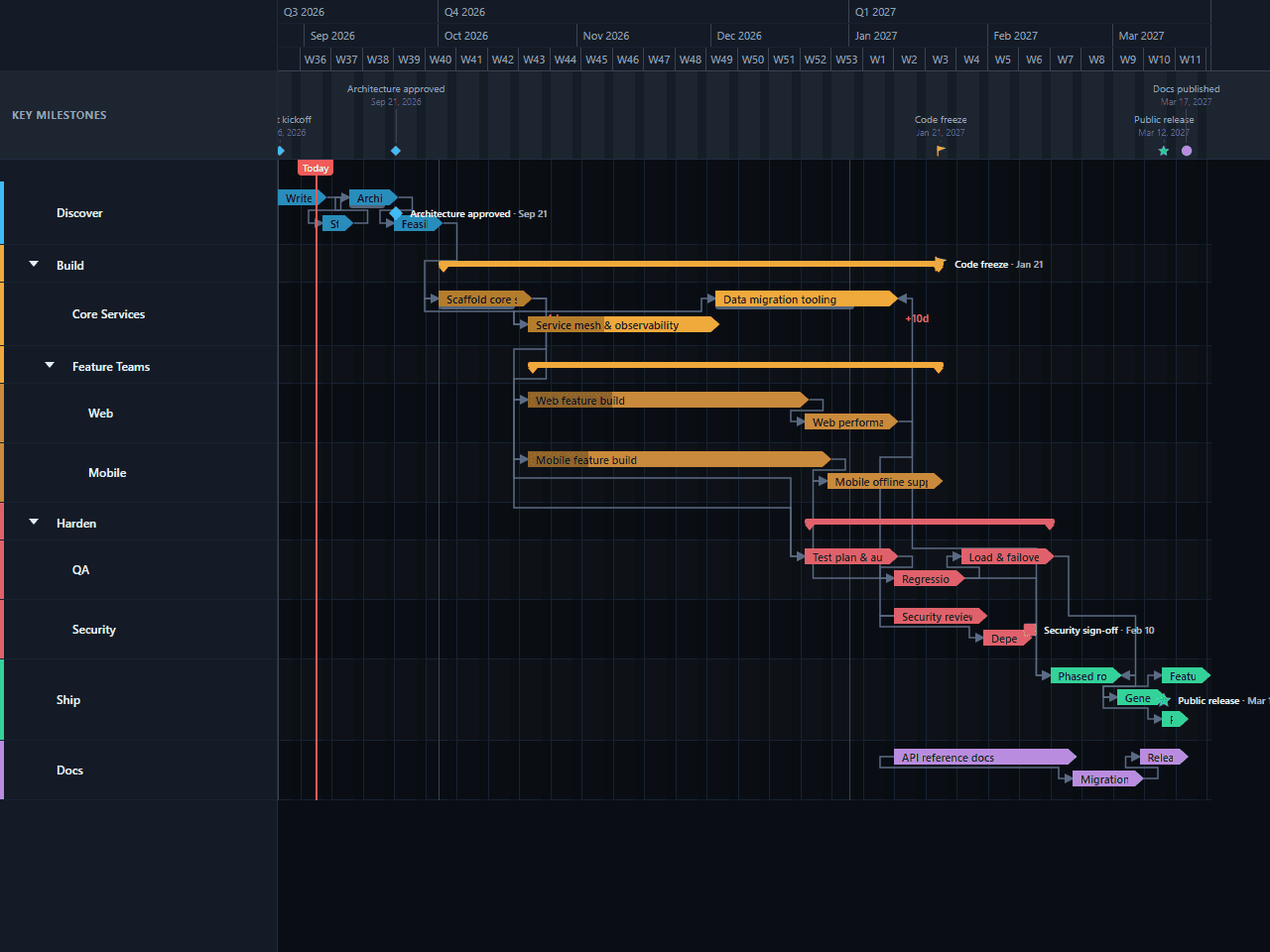
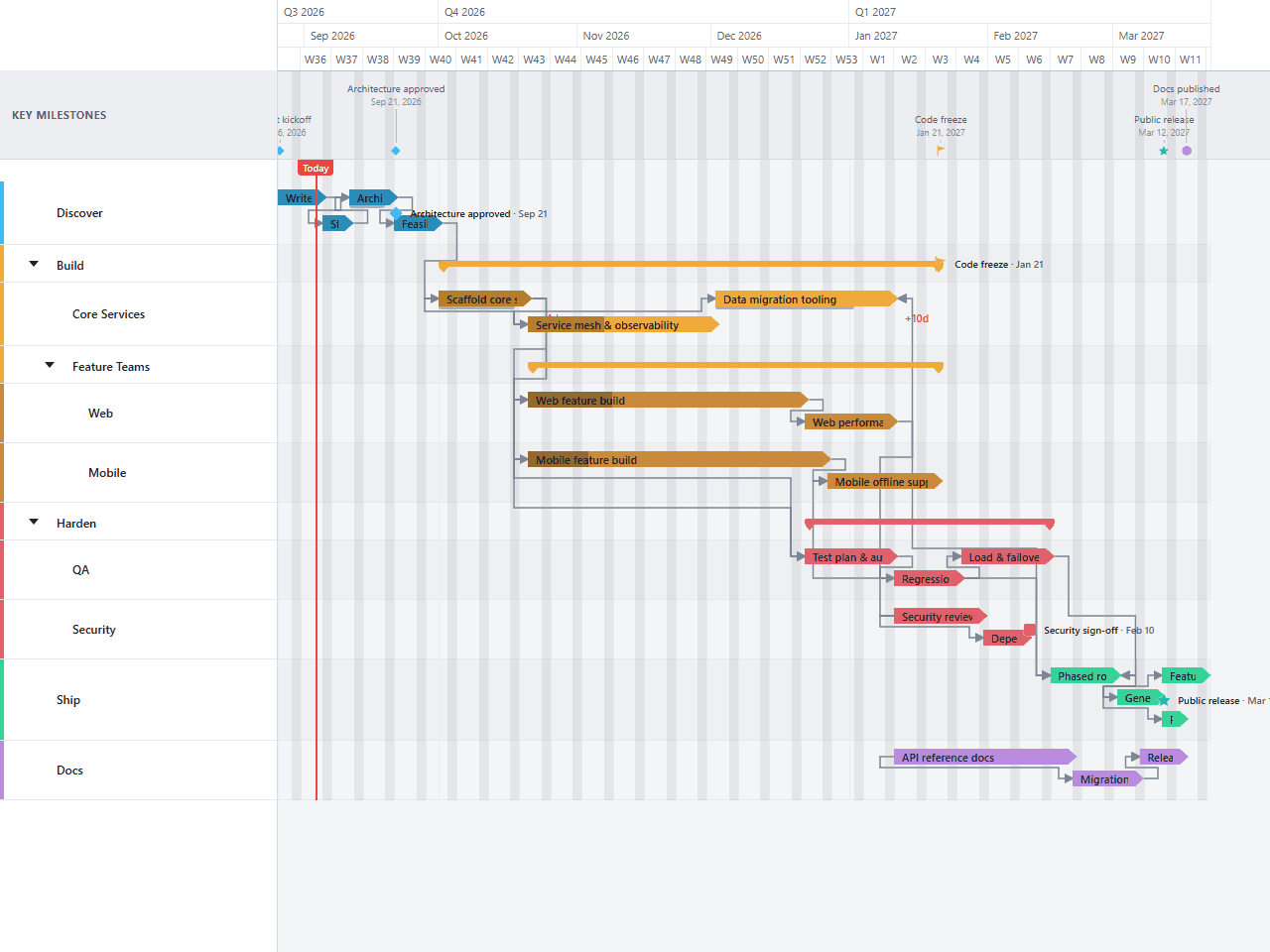
A software development roadmap moving through discovery, a three-deep build phase split across web and mobile feature teams, hardening across QA and security, and a staged ship. A start-to-finish link keeps a data-migration task honest against when security review begins, a finish-to-finish link aligns load testing with rollout, and docs run as their own track so release notes are never the thing that slips the launch. Suited to an engineering lead mapping a full release cycle from spec through rollout.
- Discover
- Build
- Harden
- Ship
- Docs
Download the plan free as a CSV: phases, tasks, dates, and dependencies, ready to open in Excel, Google Sheets, or Numbers. Open it in GanttFlow instead and it drops in as a fully editable, presentation-ready Gantt chart (Pro).
Engineering plans have a credibility problem, and it's usually self-inflicted. A roadmap drawn at ticket resolution looks precise and turns out wrong; a roadmap drawn as four featureless quarters looks honest and says nothing. This template sits between the two: four phases nested three deep across about five and a half months, with the dependencies that genuinely govern a release and nothing else.
Who this development roadmap template is for
This is for an engineering lead, tech lead, or delivery manager who owns a release and has to explain it upward. It assumes a substantial piece of work (a major version, a platform rewrite, a new product surface) with real architecture decisions at the front and a real rollout at the back.
The audience is generally not other engineers. Engineers have the tracker. This is the chart for a product counterpart, an executive sponsor, or a customer-facing team who need to plan around your dates.
What are the phases of a software development roadmap?
Four top-level lanes, one of them three deep, plus docs running alongside.
Discover covers the technical spec and the architecture review that signs it off, running right at the chart's own start.
Build splits into Core Services (scaffolding, a service mesh, and data migration tooling) and Feature Teams, itself split into Web (a feature build) and Mobile (a feature build, then offline support). This is the longest phase by a wide margin.
Harden splits into QA (a test plan and automation setup, then load and failover testing) and Security (a security review, then a dependency and license audit). Deliberately separate sub-lanes, for reasons worth defending in any planning meeting.
Ship covers the phased rollout, general release, and the flag cleanup and rollback drill that follow it.
Docs runs as its own top-level lane (API reference, a migration guide, then release notes), so documentation is never the thing quietly slipping behind the code.
How long does each phase take?
Roughly five and a half months end to end, distributed unevenly on purpose.
Discover runs about four weeks. Build is the longest phase at about thirteen weeks: Core Services alone runs from scaffolding through data migration tooling in about ten weeks, while Web runs about four weeks of feature work and Mobile runs about nine and a half across its build and offline support. Harden runs about seven weeks across QA and Security together. Ship runs about four and a half weeks, and Docs runs about nine weeks, mostly overlapping Harden and Ship rather than following them.
The ratio to notice is that hardening alone runs seven weeks, not the "final sprint" most plans allow it. Teams routinely plan it as a fortnight and then discover that a penetration test has a three-week lead time. Drawing it at honest length is the main reason to use this template rather than a two-phase build-and-launch chart.
Which dependencies govern a release?
Fourteen links, deliberately few. Five are finish-to-start and form the spine: scaffolding gates both the web and mobile feature builds directly, mobile's feature build feeds its own offline-support work, phased rollout feeds general release, and the migration guide feeds release notes.
Eight links are start-to-start, mostly keeping a successor tied to when its predecessor begins rather than a fixed date: the service mesh to scaffolding, test plan and automation setup to both feature builds, the license audit to the security review, mobile offline support to the phased rollout, and both the rollback drill and flag cleanup to general release.
One link is start-to-finish, and it's the one worth naming directly: data migration tooling's completion is gated by when security review starts, not by review finishing. Migration finishes a week after review begins, once it has a stable target to assess.
The example treats hardening as controlling work with limited parallelism. GanttFlow does not calculate a critical path or float, so confirm whether security review controls your rollout date before presenting the schedule.
What to change for your own release
Set the kickoff and shift the linked chain
Hold Shift while dragging the spec bar to your planned start date if every downstream task should move by the same offset. A normal drag moves only the spec bar. Review the release date afterward; GanttFlow does not recalculate it from dependency constraints.
Replace the feature-build bars with two or three real ones per team
One long "feature build" bar per platform is the template's biggest simplification. Split each into the deliverables you'd actually report on separately.
Check the hardening lead times against reality
If your security review is outsourced or your load testing needs an environment you don't yet have, those bars are longer than the template assumes. This is the cheapest correction you can make and the one most likely to save the date.
Set code freeze and public release as committed dates
These are the two milestones anyone will remember. Kickoff is context; those two are commitments.
Baseline after the architecture review
Not before. The plan before architecture review is a guess; the plan after it is a commitment, and that's the version worth comparing against for the rest of the release.
Common mistakes on engineering roadmaps
Folding hardening into build. It disappears, and then it's discovered at the point where there's no time left for it.
Drawing sprints. Cadence is not structure. A roadmap of a dozen identical two-week bars conveys less than four honest phases.
Equal confidence across the chart. The bars months out aren't as firm as the ones next month, and presenting them identically is how roadmaps lose credibility.
No migration or docs work. Both are invisible to stakeholders, both are always required, and both are always underestimated.
Rebuilding rather than dragging. Keep the baseline and move the bars. A release that's visibly slipped for a stated reason is far more trustworthy than one that's been redrawn with no history.
Presenting the release plan
This is a chart that gets attached to planning documents, shown in steering meetings, and forwarded to teams who need to schedule around your dates. Export a PDF at each phase boundary and a PNG whenever the bars move. Recipients read it without needing an account or any knowledge of your tooling, which is what makes it useful outside engineering.
Questions about this template
- What is a software development roadmap?
- A timeline showing how a release moves from specification to public availability, broken into phases rather than tickets. This template uses four (discover, build, harden, ship), nested three deep across roughly five and a half months, with docs running as its own track alongside the code. It sits above your issue tracker: the tracker answers what's being worked on today, the roadmap answers when the release lands and what has to happen first.
- Why is hardening split into QA and Security rather than one lane?
- Because they have different owners, different lead times, and are frequently blocked on different external parties: QA needs an environment, Security needs a review slot that might be outsourced. This template gives them separate sub-lanes precisely so a schedule risk in one doesn't get buried inside a single generic "hardening" bar.
- What does the start-to-finish link between security review and data migration mean?
- That data migration tooling's *completion* is gated by when security review *starts*, not by security finishing. Migration finishes a week after review begins, once it has a stable target to assess; it doesn't need review to be fully signed off first. A finish-to-start link would force migration to wait for security to be fully complete, which is a stricter and less realistic constraint.
- Should I put every sprint on the roadmap?
- No. Sprints are a delivery cadence, not a plan structure, and a roadmap divided into a dozen two-week bars tells a reader nothing they couldn't get from a calendar. Keep phases on the roadmap and sprints in the tracker. If you need to show cadence, add milestones at release boundaries instead.
- How far ahead can a development roadmap be trusted?
- About one phase further than the one you're in. The discovery bars in this template are firm, the build bars are estimates, and the ship bars are placeholders until hardening is underway. Saying that explicitly when you present it is more useful than drawing every bar with equal confidence and being wrong later.