
Product Launch Gantt Chart Template
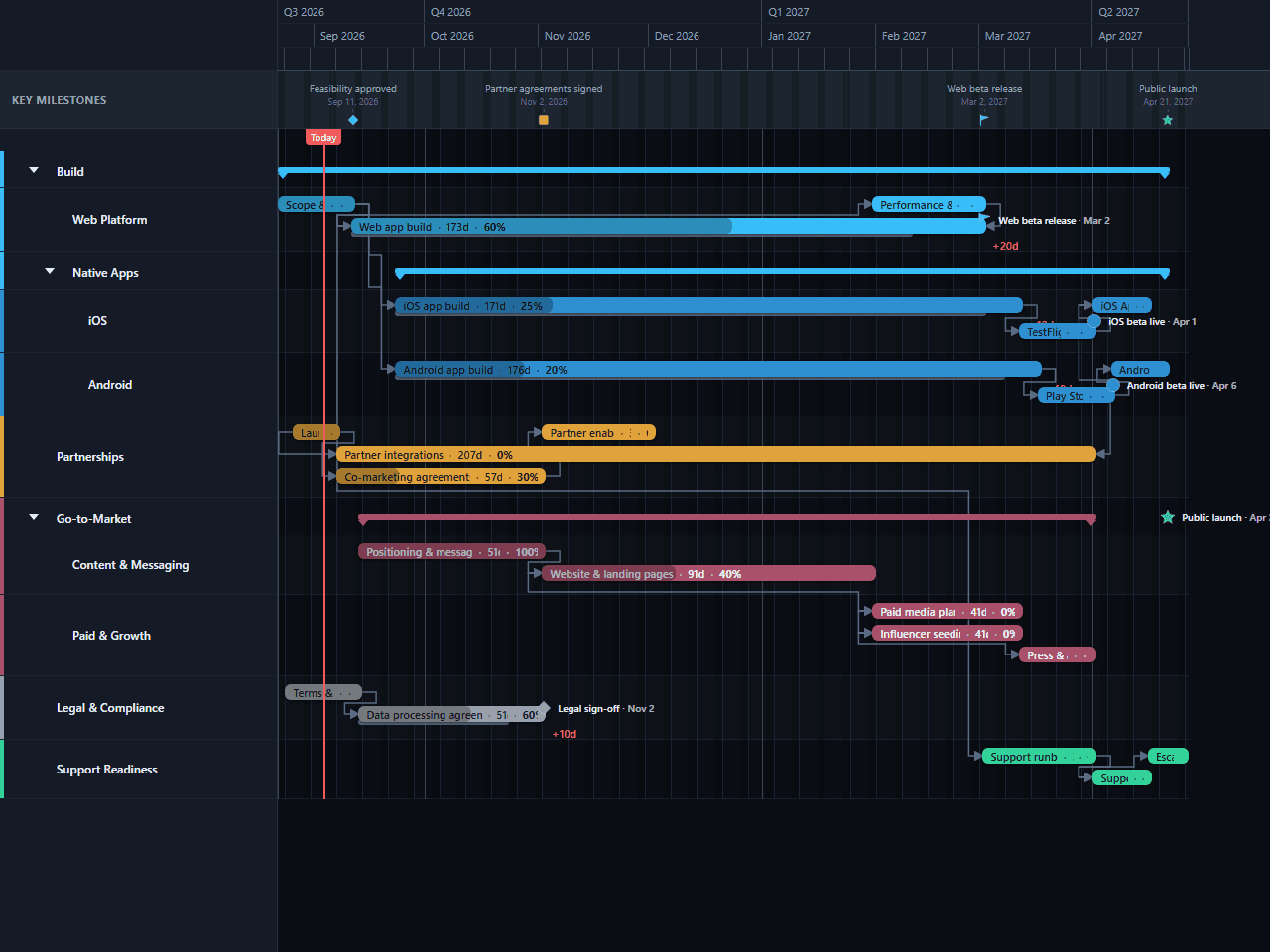
A product launch timeline tracking a web build alongside native iOS and Android builds — nested three deep under Build — plus partnerships, a two-track go-to-market (content and paid/growth), legal sign-off, and support readiness, all converging on one launch date. A start-to-finish link keeps partner integrations honest against when the iOS submission actually starts, and a finish-to-finish link ties a performance and accessibility audit to the web build finishing at the same time. Progress percentages show how each workstream is tracking, with beta milestones on every platform ahead of the final release.
- Build
- Partnerships
- Go-to-Market
- Legal & Compliance
- Support Readiness
Download the plan free as a CSV: phases, tasks, dates, and dependencies, ready to open in Excel, Google Sheets, or Numbers. Open it in GanttFlow instead and it drops in as a fully editable, presentation-ready Gantt chart (Pro).
Product launches fail at the seams. The build is fine, the messaging is fine, the partner integration is fine, and they're ready in the wrong order, weeks apart, with a press date already booked. This template puts five tracks on one chart for exactly that reason, across a six-month cycle with an Android beta going live before the public date.
Who this product launch template is for
This is for whoever owns the launch date across functions: a product lead, a launch manager, a founder. It assumes a substantial launch: a web platform and at least one native app, an external partner, and a go-to-market effort that starts long before launch week.
The audience is cross-functional by definition. Engineering needs to see the go-to-market dependencies, marketing needs to see the build reality, and leadership needs to see whether the date holds. That's why it's one chart rather than five.
What are the phases of a product launch plan?
Five top-level lanes, one of them nested three deep.
Build splits into Web Platform (scoping, then the web app build) and Native Apps, itself split into iOS (a build, TestFlight beta, then App Store submission) and Android (a build running the length of the phase).
Partnerships covers launch-partner NDAs, then the partner integration work itself.
Go-to-Market splits into Content & Messaging (positioning, then the website and landing pages) and Paid & Growth (a paid media plan keyed to the landing pages).
Legal & Compliance covers terms and privacy policy review, then data processing agreements.
Support Readiness covers the support runbook, team training, and an escalation path with engineering.
Five milestones: feasibility approved, partner agreements signed, legal sign-off, the Android beta going live, and public launch.
How long does each track take?
About six months end to end.
Build is the longest track at roughly twenty weeks: the web build runs alongside the iOS and Android builds, with iOS carrying an extra beta and submission tail into January. Partnerships spans about nineteen weeks once integrations run their full course. Go-to-Market spans about twenty weeks. Legal closes in about ten weeks, with the data processing agreements task currently tracking about a week and a half behind its baseline. Support Readiness runs the final ten weeks of the programme, closing out around public launch rather than stopping cold before it.
The most consequential figure to preserve is that partner integrations run for most of the programme, not as a short bar tucked after the NDAs close; partner-facing work stays open far longer than a simple "integrate once" task would suggest.
Which dependencies matter for a launch?
Ten links, deliberately few. Eight are finish-to-start, the strict kind: scoping finishes before both the web and Android builds start; the iOS build finishes before TestFlight starts; TestFlight finishes before App Store submission starts; the partner NDAs finish before integration work starts; positioning finishes before the landing pages start; and the support runbook finishes before team training starts.
Two are start-to-start: the paid media plan is keyed to when the landing pages start, not when they're finished, and the escalation path with engineering is keyed to when support team training starts, both let a successor begin in step with its predecessor rather than waiting for a separately-tracked handoff date.
GanttFlow does not calculate or verify a critical path, so confirm which chain actually controls your launch date before you present it.
What to change for your own launch
Set the public launch date and work backwards
Launches usually have a fixed external date: an event, a fiscal quarter, a partner announcement. Anchor it, then let the dependency chain show you when scoping had to start.
Check the gap between your last beta and launch
This template runs about three weeks from the Android beta going live to public launch. If yours is under that and you ship a native app, that's the single riskiest assumption in your plan.
Add a bar for every partner
One integration bar is a simplification. Each partner has their own calendar and their own capacity to be late, and each deserves to be visible.
Keep the paid-media gap tied to content, not a date
Resist replacing the start-to-start link with a fixed calendar date. Paid spend keyed to content readiness, not a deadline, is what stops the ads outrunning a page that isn't live yet.
Baseline once the build estimates are grounded
A baseline set at kickoff is a baseline set against guesses. Set it once the web and native builds have real velocity behind them.
Common mistakes on launch plans
One "product" bar. Web, iOS, and Android have different risks and different external gatekeepers.
Marketing on a separate chart. Guarantees the two plans drift and that nobody notices until launch month.
No beta milestone. Without one there's no checkpoint at which someone can say the date is at risk while there's still time to move it.
Partner work starting after the build. Partners aren't a downstream task; they're a parallel organisation with their own quarter.
Skipping TestFlight before submission. This template's finish-to-start link between the two exists to catch exactly that shortcut; submission before internal feedback lands defeats the point of running a beta at all.
Sharing the launch plan
A launch plan is read by engineering, marketing, partners, and leadership: four audiences who share almost no tooling. Export a PDF for the partner pack and a PNG for the weekly launch stand-up, and re-export as the bars move. None of those recipients needs an account to open it, which is what lets one chart serve as the shared reference instead of four divergent copies.
Questions about this template
- How far ahead should a product launch be planned?
- This template spans about six months from technical scoping to public launch, with an Android beta going live a few weeks before the end. That's a realistic shape for a launch involving a web build, two native apps, and partner integrations. Launches planned in under three months almost always cut the partnership track, which is the one with external dependencies you don't control.
- Should web and native builds be separate bars?
- Yes, always, and this template goes further: iOS and Android are separate bars nested under Native Apps, with iOS carrying its own TestFlight beta and App Store submission steps. They have different teams, different review processes, and critically different release mechanics, since app store review is outside your control. Collapsing them hides the fact that one platform can be ready while the other is stuck in review.
- Why does the iOS App Store submission follow TestFlight rather than run alongside it?
- Because submission needs a build TestFlight has already validated, a finish-to-start dependency, the strict kind, on purpose. Betas exist to catch what internal testing misses, and submitting before that feedback lands defeats the point of running a beta at all. Most of this template's links are this same plain kind: only the paid-media and support-training links are keyed to a predecessor's start rather than its finish.
- What is the difference between a beta milestone and a launch milestone?
- A beta is a readiness checkpoint you control; a launch is a commitment you've told the market about. This template marks the Android beta going live as its own milestone, separate from the public launch that follows months later. Treating a beta as a launch creates pressure to ship something unfinished; treating a launch as a beta creates a credibility problem with everyone outside the team.
- How do I keep go-to-market and engineering on the same plan?
- Give them separate lanes on one chart rather than separate charts. This template runs Build, Partnerships, Go-to-Market, Legal & Compliance, and Support Readiness in parallel so a positioning delay and an engineering delay are visible in the same view. Two separate plans is how marketing ends up ready weeks before the product is.