
Marketing Campaign Gantt Chart Template
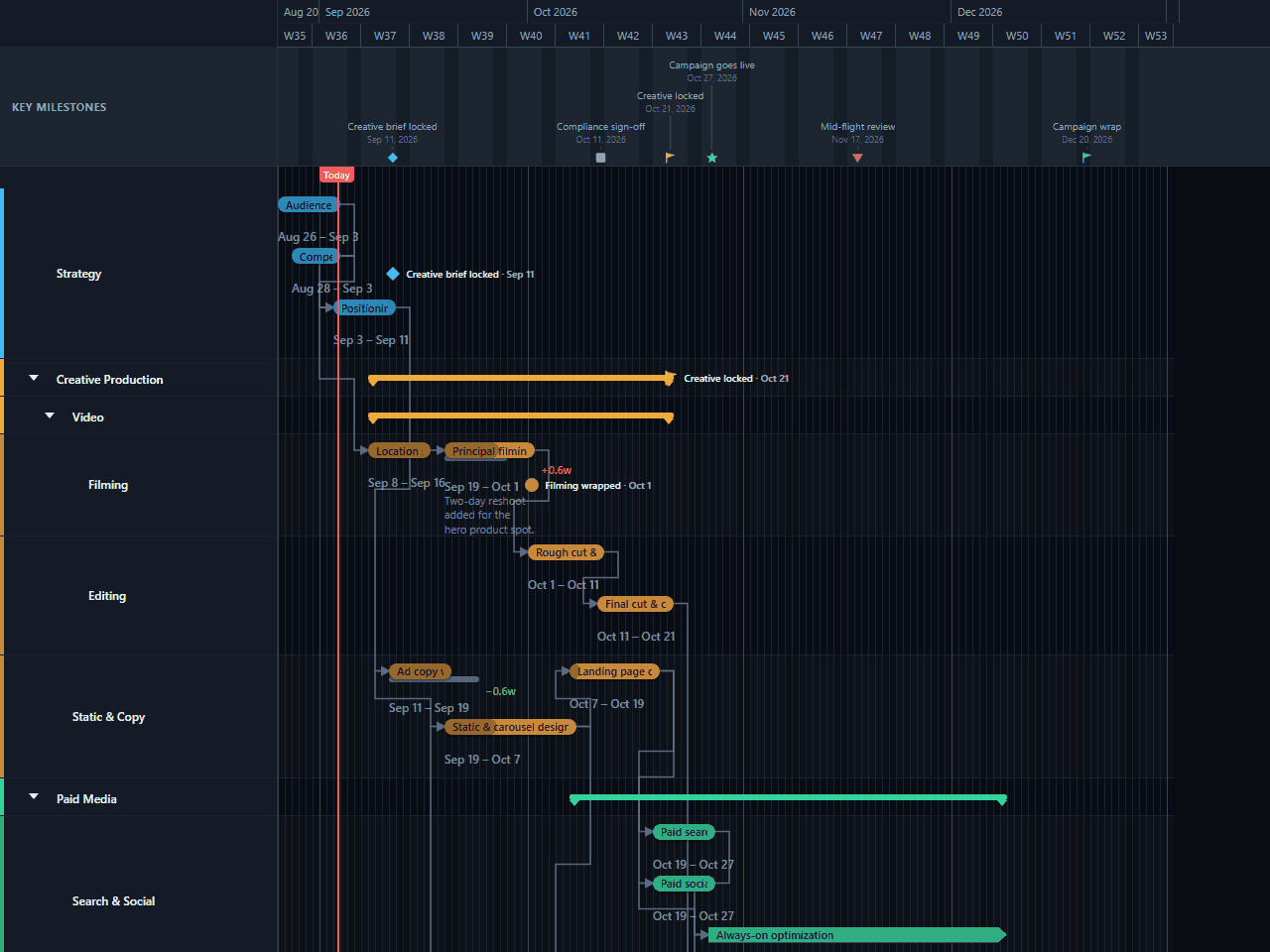
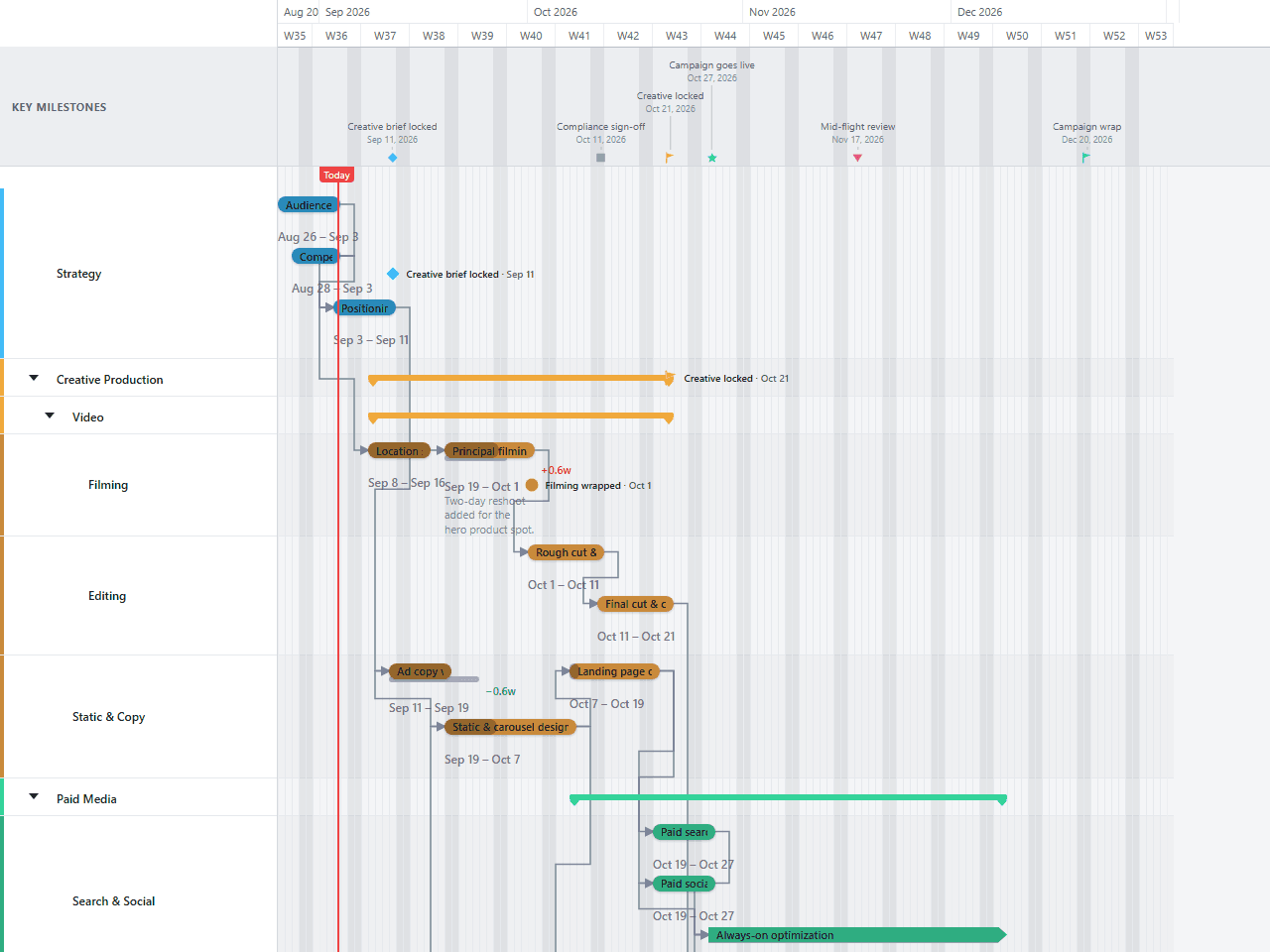
A full-funnel marketing campaign plan running strategy, a three-deep creative production pipeline, paid media, organic and partner outreach, and legal sign-off as parallel tracks that converge on one launch day. Baselines show where the video shoot slipped, a start-to-finish link keeps legal review honest against the creative timeline, and a mid-flight review milestone sits ahead of the final report — built for a marketing lead running more than one workstream at once.
- Strategy
- Creative Production
- Paid Media
- Organic & Partnerships
- Compliance & Legal
- Launch & Analysis
Download the plan free as a CSV: phases, tasks, dates, and dependencies, ready to open in Excel, Google Sheets, or Numbers. Open it in GanttFlow instead and it drops in as a fully editable, presentation-ready Gantt chart (Pro).
A campaign plan has an unusual job. It has to satisfy a creative team that wants room to work, a compliance function that wants lead time, a paid-media function that wants a stable brief, and a stakeholder who mostly wants to know what date the thing goes live. This template is arranged around all four at once: six top-level lanes, two of them split into sub-lanes, running about fourteen weeks from first research to the post-mortem.
Who this marketing campaign template is for
This is for whoever owns the launch date. Usually a campaign manager or marketing lead running a product launch, a seasonal push, or a rebrand, someone coordinating copy, video, paid placements, partners, and legal, with a fixed go-live they've already promised someone.
It assumes the campaign is substantial enough to need produced video, has at least one approval gate outside the marketing team, and runs paid and organic channels as genuinely separate efforts. If your campaign is a single email and a social post, you probably need a content calendar rather than a Gantt chart.
What are the phases of a marketing campaign plan?
Six top-level lanes, two of them nested.
Strategy covers audience segmentation, a competitive and seasonal read, and the positioning brief those two feed. Segmentation starts right at the chart's own zero point.
Creative Production splits into Video (itself split into Filming and Editing) and Static & Copy. Video is where the schedule risk lives: location scouting, principal filming (currently four days behind its baseline after a two-day reshoot), a rough cut, then the final grade. Static & Copy runs the landing page copy that feeds the paid-media setup.
Paid Media splits into Search & Social (paid search and social setup, then an ongoing always-on optimization bar) and Display & Retargeting (display creative trafficking, then the retargeting audience it feeds).
Organic & Partnerships covers influencer and partner outreach, the co-marketing assets that follow, and an organic social calendar running well past launch.
Compliance & Legal is a single lane holding the legal and brand review, deliberately its own top-level lane, not folded into production.
Launch & Analysis covers the launch-day war room, a mid-flight performance review, and the results report and post-mortem.
How long does each phase take?
About fourteen weeks end to end, front-loaded toward creative production.
Strategy runs about two and a half weeks, closing when the positioning brief locks. Creative Production is the longest phase: the video track alone, from scouting through the final grade, runs a little over five weeks, and the shoot itself is currently tracking four days behind its baseline after a two-day reshoot. Paid Media spans about five weeks once display creative trafficking starts, though most of that is the always-on optimization bar running through the rest of the campaign. Organic & Partnerships runs the longest single lane, because the organic calendar keeps going into early December, well past launch. Compliance review itself takes about two and a half weeks, sitting inside the production window rather than after it.
The proportion worth defending is that creative and compliance both close before Paid Media properly ramps: paid search and social setup don't start until the landing page copy is far enough along to link to. Every compressed campaign compresses that front half first, and every compressed front half produces creative nobody can explain the reasoning behind.
Which dependencies matter in a campaign timeline?
Seventeen links. Most of the chain (twelve of them) is finish-to-start: segmentation and the seasonal read both finish before positioning starts; positioning finishes before scouting starts; the rough cut finishes before the final grade starts; and so on down each lane.
Four links are start-to-start, and the one worth pointing at directly is scouting: it's tied to when the positioning brief starts, not when it's signed off, a video shoot has its own lead time that can't wait on final copy sign-off.
One link is finish-to-finish: the final cut and display creative trafficking are drawn to finish on the same day. The arrow communicates that intent; it does not enforce the dates.
GanttFlow does not calculate or verify a critical path, so confirm which chain actually controls your launch date before you present it.
What to change for your own campaign
Anchor the go-live milestone first
Unlike most plans, a campaign usually has a fixed end. Place the launch milestone on the committed date, then work backwards and position the video, paid-media, research, and production bars. Links show the intended relationships, but GanttFlow does not schedule those bars automatically.
Rename the sub-lanes to match your own production pipeline
Video and Static & Copy are one shape of creative production. If yours also includes audio or influencer-produced content, add a sub-lane rather than cramming it into an existing one.
Be honest about the approval gates
The template has one legal review. If your organisation has brand, legal, and regional approval as three separate gates, add all three as their own bars: approvals that aren't on the chart are the ones that surprise you.
Set the six milestones to real commitments
Creative brief locked, creative locked, compliance sign-off, campaign goes live, mid-flight review, and campaign wrap. Creative locked is the one people underestimate: it's the date after which changes cost money.
Extend the optimization bar to match your reporting cycle
Always-on Optimization currently runs to the report date. If you report monthly instead, stretch it and add a milestone at each reporting point.
Common mistakes on campaign timelines
Treating launch day as the end. The chart should extend past go-live through monitoring and the post-mortem. Campaigns that end at launch on the chart tend to end at launch in practice too, which is where the budget gets wasted.
Folding paid and organic into one lane. They're owned by different people with different failure modes; collapsing them hides which one is actually behind.
Leaving compliance off. It's not a marketing task, so it gets omitted, and then it blocks the launch. Give it a bar and a name, not a footnote inside production.
One "creative" bar. Copy, static design, video, and legal review have different owners. Collapsing them hides which one is actually late.
No creative-lock milestone. Without a visible lock date, change requests keep arriving, and each one quietly consumes the buffer in front of the launch.
Presenting the campaign plan
Campaign plans get forwarded more than most, to agencies, to channel partners, to a finance lead approving the spend. Export a PDF once the dates are agreed, and re-export a PNG for each weekly stand-up as the bars move. Because the recipient never needs an account to read it, the plan stays useful right through the campaign rather than becoming a document only you can open.
Questions about this template
- How far in advance should a marketing campaign be planned?
- This template runs about fourteen weeks from the start of audience research through the post-mortem, with roughly nine weeks of that before the campaign goes live. That is a realistic minimum once video production, legal review, and paid media setup are all real tracks rather than placeholders. Campaigns built in under a month almost always cut research or compliance, and it is usually research.
- Why does location scouting start before the messaging brief is finished?
- Because a video shoot has its own lead time that can't wait on final sign-off. The template links the brief to scouting as a start-to-start dependency rather than finish-to-start, so scouting begins once positioning direction exists, the same day the brief itself starts. Modelling it honestly is what stops the plan from claiming a launch date the video track can't hit.
- Why is legal and compliance review its own lane, not folded into production?
- Because burying compliance inside production is the single most common reason campaign launches slip; it becomes invisible until it blocks something. This template gives it a real bar with real duration, running for most of October, so its own progress is something a scanning stakeholder can actually see rather than something they discover is late the week before launch.
- Can I use this for an always-on channel rather than a single launch?
- Yes, with one change. Delete the results-report task and extend Always-on Optimization across your reporting period, adding a milestone at each review point. The research and production lanes stay as they are; even always-on programmes get periodically refreshed creative.
- Why do Paid Media and Organic & Partnerships run as separate lanes?
- Because they're owned by different people and fail in different ways. Paid spend can be paused the moment something looks wrong; a partner co-marketing commitment can't be un-made once it's live. Splitting them keeps a paid-media problem from reading as an organic one, and vice versa, to anyone scanning the chart.